


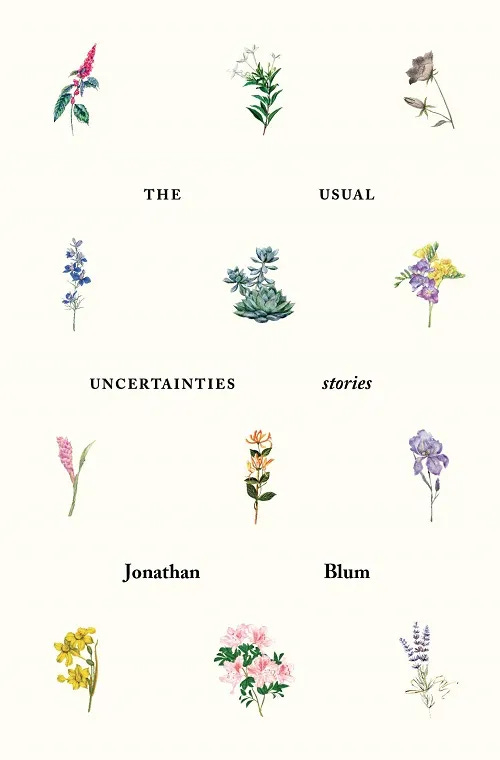
Our September hybrid Zoom session originated from the conference room at the Jewish Federation, thanks to Steve Lotter setting up the technology. Joining us from Los Angeles was author Jonathan Blum, whose collection, The Usual Uncertainties, offered something different from our usual fare. These stories of Jewish literary fiction are mostly first-person narratives, each distinct in voice and style, with settings reaching back to the 1950s.
Readers appreciated the richly drawn characters, but some wished for endings that resolved their dilemmas. Blum explained his preference for endings that allow readers to infer what might happen next. He recalled Grace Paley’s phrase, “the open destiny of life.” As long as we are alive, he observed, our choices can take us in different directions. His characters retain that possibility.
The Los Angeles story prompted differing interpretations of a relationship: was it love, exploitation, or a question of trust? Blum’s explanation of the insecurity faced by an undocumented immigrant added another perspective. He described drawing on observations from nine years of teaching ESL, rather than modeling the characters on particular people. A first-person narrator gives us privileged access to one person’s thoughts, he explained, but the writer must also understand the people whose thoughts remain outside that narration.
Readers noted the variety of voices, the Yiddish speech patterns without stereotypical Jewish behavior, and the humor of the bar mitzvah square dance story. “Dignity Shores” drew especially warm responses for Marcia’s compassion. One member connected it with experiences working at the Hebrew Hospital for the Aged in the Bronx. Blum spoke of his single mother and the women who taught him at Jewish day school as positive influences he brought to Marcia. Stories need problems, he said, but also love and tenderness.
We gained further insights into writing through “Panels,” the collection’s very short pieces. Blum described them as works shaped by deliberate restrictions, occupying a space between poetry and short fiction. He asks students to reduce a 500-word story to 300 words to discover its essence: what can be removed, and what must remain?
His connection between those writing practices and growing up in an observant Jewish home was particularly revealing. Dietary laws and Sabbath observance had made restrictions familiar; in writing, he finds rules he sets for himself helpful. Hearing the author discuss his choices gave us a fuller appreciation of how these stories were made—and why their uncertainties leave so much for readers to consider.
Beth Buechler, Community Contributor
Upcoming Book Discussions (Subject to Change):
October 8: The Astral Library by Kate Quinn (Magical Realism)
November 12: The Secret Book Society by Madeline Martin (Historical Fiction)
December 10:Heart of a Stranger by Angela Buchdahl (Memoir, Spiritual Guide)
Unless otherwise directed, the Federation Book Club meets via Zoom at 4 PM on the 2nd Thursday of the month.
Contact info@thejewishfed.org with “Book Club” in the subject if you’d like to join.
